Inference Provider API
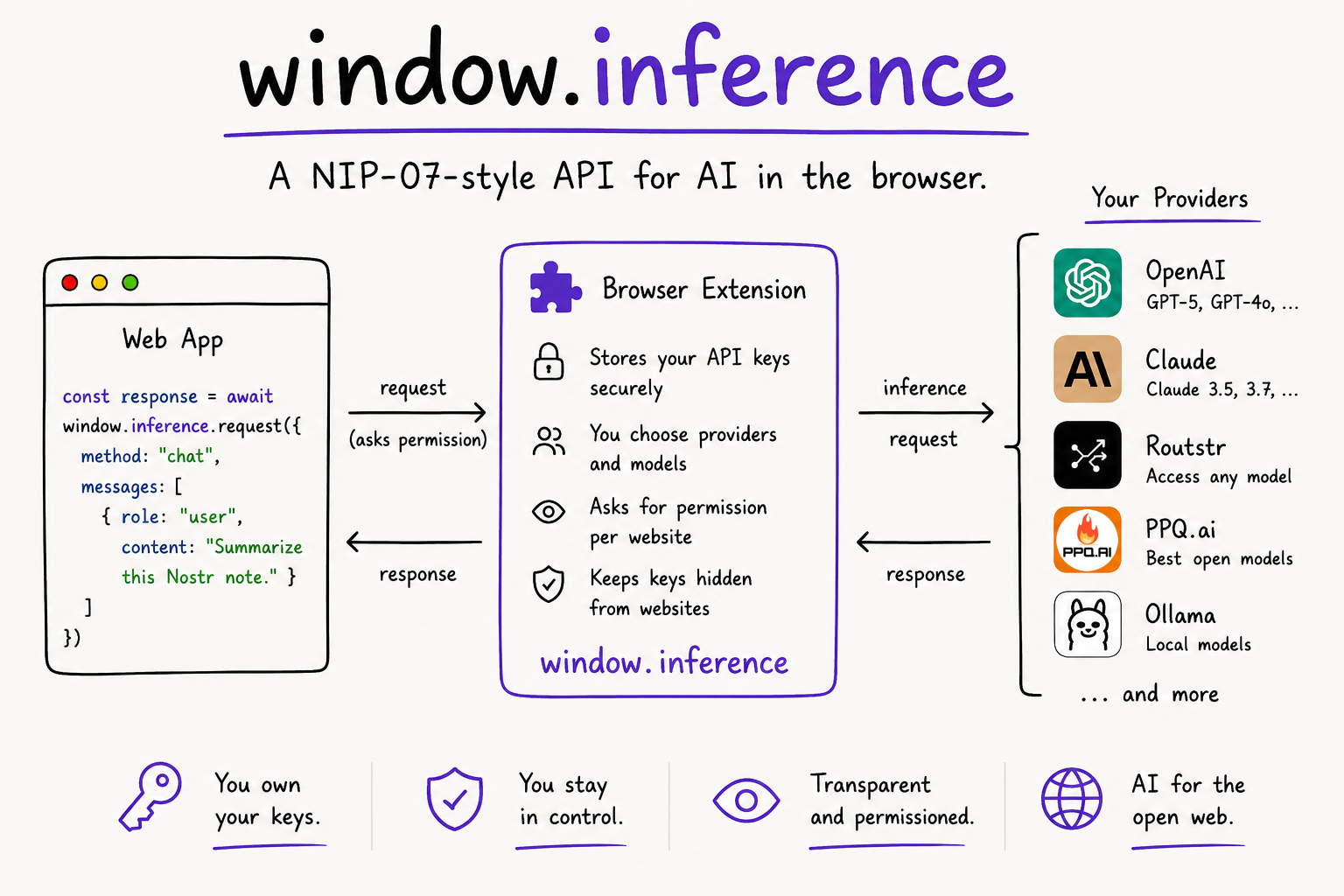
Proposal: Inference Provider API
The Inference Provider API (IPA) is a proposed browser standard that allows web applications to request AI inference from a user-approved browser extension without ever accessing API keys.
Think of it as NIP-07 for inference providers.
The Problem
Today, every AI-powered web app has to:
- Ask users for API keys
- Proxy requests through their own backend
- Charge subscriptions for inference
- Integrate every provider separately
This creates a poor user experience and makes inference features harder to build.
The Idea
A browser extension securely stores the user’s inference providers and API keys, then exposes a standard interface to web apps.
window.inference.request(...)
The extension prompts the user for permission whenever a site requests inference.
The website never sees the API keys.
Example
const response = await window.inference.request({
  method: "chat",

  preferredModel: "gpt-5",

  messages: [
    {
      role: "user",
      content: "Summarize this Nostr note."
    }
  ]
})
User Permission
When a website requests inference, the extension displays a permission dialog.
primal.net wants to use inference

Suggested model
GPT-5

Use:

○ GPT-5
● Claude Sonnet 4
○ PPQ Auto
○ Gemma 4 (Local)

Estimated Cost
$0.0012

[Allow Once]
[Always Allow]
[Deny]
The application can suggest a model.
The user chooses the provider and model.
Users Choose Their Provider
The same application could work with:
- OpenAI
- Anthropic Claude
- Google Gemini
- xAI Grok
- OpenRouter
- ppq.ai
- Routstr
- Ollama
- LM Studio
- etc.
The application doesn’t care where the inference comes from.
Example Configuration
Default Provider
✓ Claude

Default Model
✓ Claude Sonnet 4

Available Providers

• OpenAI
• Claude
• ppq.ai
• Routstr
• Ollama
Tomorrow the user switches to OpenAI.
The application doesn’t change.
Next week they switch to ppq.ai.
The application doesn’t change.
Eventually they buy a powerful local inference machine and switch to Ollama.
The application still doesn’t change.
Permission Model
The extension controls permissions per origin.
primal.net

Allowed

✓ Chat
✗ Images
✗ Embeddings

Preferred Model
GPT-5

Default Model for this Site
Claude Sonnet 4

Always use this model ✓
Benefits
- Users own their API keys.
- Websites never store secrets.
- BYOK becomes the default.
- Inference features become dramatically easier to add.
- Users choose their preferred provider and model.
- Applications become provider agnostic.
- Local inference works automatically.
Possible Future Methods
window.inference.request({
  method: "chat"
})

window.inference.request({
  method: "embed"
})

window.inference.request({
  method: "image"
})

window.inference.request({
  method: "transcribe"
})

window.inference.request({
  method: "search"
})
Example Use Cases
- A “Grok” button on every Nostr note.
- AI-powered documentation sites.
- Browser-based coding tools.
- Research assistants.
- Translation.
- Writing assistance.
- Local-first applications.
Write a comment