Causes, Benefits and Costs of International Trade
On Thursday, asked about the quite scary prospect of soaring prices and shortages resulting from the apparent collapse of Chinese shipments of goods to the United States, Donald Trump responded
That means we lose less money … when you say it slowed down, that’s a good thing, not a bad thing
OK, Trump doesn’t understand what international trade is all about. But the truth is that even generally well-informed readers often know less about the basics of trade than economists tend to assume.
So this is a primer on the basics of international trade. For the most part it covers the same material encountered by every student taking Economics 101. But I thought I might add some value by presenting these basics in a more conversational style than most textbooks (my own with Robin Wells included), offering more real-world examples, and paying more attention to the shadows — the reasons even generally pro-trade economists, myself included, think that simply shouting “Yay free trade!” isn’t sufficient.
Beyond the paywall I will cover:
1. The reasons nations trade with each other
2. The benefits of trade
3. The costs of trade
Why nations trade
When I was in 7th grade, our Social Studies class was forced to read The Golden Age of Homespun, a paean to the largely self-sufficient farmers of the early 19th century. My classmates and I — suburban kids whose fathers commuted into New York every day and who bought stuff in strip malls — were pretty contemptuous of the book’s nostalgia. And we were right: It would be foolish for families to seek self-sufficiency given the opportunities offered by the modern economy.
The same goes for countries. There are very good reasons for nations to produce different things and trade for the goods and services they don’t produce.
Notice that I said “reasons,” plural. There are in fact two distinct reasons countries find it advantageous to produce different things — the same reasons it makes sense for individuals to specialize and buy stuff from other people rather than trying to be self-sufficient.
First, people are different. Imagine that Jack and Jill are two smart, ambitious young people who have just entered college. Why might Jack become a lawyer while Jill becomes a surgeon? Well, maybe Jill has steady hands but hates arguing, while Jack has a phenomenal memory but can’t stand the sight of blood.
Second, there are inherent advantages to mastering one trade rather than dabbling in many areas. This is obviously true for jobs that require a lot of formal education: Nobody has the time to become both a surgeon and a top-flight lawyer. But it’s also true for skills that aren’t taught in universities. It takes a lot of practice and experience to become a good plumber, which anyone who’s hired a bad one knows all too well.
The same logic drives trade between countries.
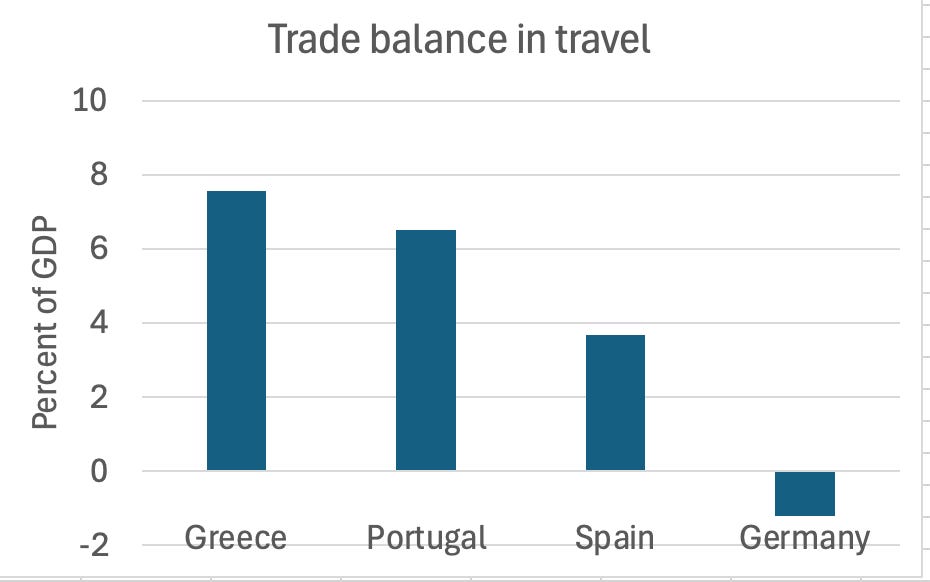
One major reason nations specialize and trade is that they are different, and trade to take advantage of those differences. A clear real-world example is trade in travel services, aka tourism, within Europe. Don’t sneer: In the modern world tourism is big business, and a major source of income and employment in some economies. So here’s net exports of travel services as a percent of GDP for some southern European nations and Germany (which has a much bigger economy):

Source: World Trade Organization
It's obvious why tourism is a net export for southern Europe but an import for Germany: Greece et al have warm weather and beautiful beaches, while Germany has currywurst.
Now, Spain exports tourism services to Germany because it’s simply better at providing a pleasant vacation much of the year. But countries will also specialize and trade even if some of them are better than others at almost everything.
My favorite example is garment production. The United States doesn’t have much of an apparel industry left, but if it did, we can be sure that our workers would be more productive than workers in Bangladesh, in the sense that the average worker could make more shirts or pairs of pajamas per day. Yet Bangladesh is a big exporter of clothing, while America is a big importer. Why?
The answer is that Bangladeshi garment workers are less productive than their counterparts in America or Europe, but they’re closer to advanced-country productivity in labor-intensive industries like clothing than they are in other sectors. Their low overall productivity translates into relatively low wages, but they’re productive enough in clothing manufacturing that these low wages give them a cost advantage.
The idea that countries trade because they’re different is called the theory of *comparative advantage*. And comparative advantage is probably the biggest reason nations engage in international trade.
It is not, however, the only reason. Like individuals, nations also specialize and hence trade because there are inherent advantages to large-scale production. Sometimes these advantages are at the level of the individual production site: To be efficient, an auto assembly plant has to produce several hundred thousand cars a year. Often, however, the advantages of scale accrue not to an individual facility but to a local cluster of producers. Clustering promotes technological spillovers, supports specialized suppliers of services, and provides a deep labor market for skilled labor.
A clear example of the advantages of clustering is the trade within Europe in “other commercial services,” which basically means finance. The UK is a huge exporter of these services:
s_!t4IM!,w_1456,c_limit,f_auto,q_auto:good,fl_progressive:steep/https%3A%2F%2Fsubstack-post-media.s3.amazonaws.com%2Fpublic%2Fimages%2Fc553ada0-7dd0-4e8c-a2e5-8def88538687_884x524.png)
Source: World Trade Organization
Why does the UK export financial services to the rest of Europe? It’s not because there’s something about the nation’s culture that make Brits especially good at managing money — in fact, 38 percent of the finance work force in the City, London’s financial district, is foreign born. What matters, instead, is that London is a good place to do financial stuff because it’s already a huge financial center.
How did London become Europe’s dominant financial center in the first place? Well, once upon a time it was the capital of a globe-spanning empire. The empire is long gone, but the financial cluster remains. This kind of story, in which historical accident gives rise to industrial clusters that then persist through self-reinforcing dynamics, is actually typical when you look at this kind of trade.
The story that international trade happens in part because of the advantages of large-scale production is called the theory of increasing returns.
As some readers may know, this is where I personally came in. I made my academic reputation as one of the developers of the so-called New Trade Theory, which helped clarify the role of increasing returns in trade. You can read more about that here.
The most familiar examples of increasing returns in trade are big, glamorous clusters like the City of London or Silicon Valley. But there are also many smaller, more prosaic examples, like the concentration of much of the world’s button production in China’s Qiaotou Township.
The actual pattern of world trade reflects both comparative advantage and increasing returns, and sometimes these forces interact. Comparative advantage surely makes it inevitable that the world’s leading financial centers are in advanced countries with highly educated work forces, while a labor-intensive, relatively low-tech activity like producing buttons will take place in an emerging market with lower wages. But the roles of both London and Qiaotou reflect historical accident locked in by self-reinforcing dynamics.
Comparative advantage and increasing returns, then, explain why international trade happens. But is trade good?
Benefits of international trade
When non-economists talk about the benefits of international trade, they often talk — as Trump did — about the money countries earn from exporting or the jobs created by export industries. These are, however, the wrong things to focus on.
Why isn’t trade about jobs? Because modern economies normally operate with close to full employment, in large part because they use monetary and fiscal policy to boost employment whenever it’s depressed. As a result, there’s basically no correlation between trade balances and the overall number of jobs. Last year, for example, the United States ran a trade deficit on goods of \(1.2 trillion, only partly offset by a surplus on services. Yet we had an unemployment rate of only 4 percent, which is historically very low. Because we’re normally operating close to full employment, any increase in employment in export industries must be offset by job losses elsewhere. So exporting doesn’t create jobs on net. If trade doesn’t create jobs, however, where’s the benefit? The answer is increased purchasing power together with lower costs for businesses that rely on imported inputs. There has recently been some interest in Barbienomics — the economics of trade in toys — thanks to Trump’s dismissive suggestion that girls don’t need 30 dolls, that two should be enough. Interestingly, he was implicitly admitting that his tariffs will make toys much more expensive, which they will. [Greg Sargent](https://newrepublic.com/article/194938/trump-dolls-weird-tariffs-scarcity) recently offered a good description of doll manufacture, emphasizing just how labor-intensive it is: > MATHPH0XENDreating dolls’ faces and attaching their hair often requires connecting the head by hand to different machines, after which lips and eyes are stenciled on and the hair (often made of nylon) is grafted to the scalp. Still another chore often done by hand is attaching arms and legs to torsos. Yet another involves the creation of dolls’ miniature clothes at sewing machines. It's no wonder that these tasks are usually carried out in nations that pay much lower wages than we do. These low wages, by the way, essentially reflect lower productivity across the board. Here’s productivity — as proxied by GDP per capita — versus average wages in manufacturing in selected countries: s_!5cqq!,w_1456,c_limit,f_auto,q_auto:good,fl_progressive:steep/https%3A%2F%2Fsubstack-post-media.s3.amazonaws.com%2Fpublic%2Fimages%2F5f72fd27-c24b-45a8-b678-6189f345faf2_1048x648.png)
Source: World Bank, Apollo Academy
Although China has made huge strides over the past 35 years, it’s still substantially less productive than the United States, and as a result pays much lower wages. But Chinese productivity is a lot closer to American productivity in toys than it is overall, and as a result China can provide toys that are much cheaper than they would be if we produced them ourselves. The same is true for clothing made in Bangladesh, and many other goods.
Trade in toys is an example of comparative advantage at work — and it makes us richer by increasing our purchasing power. What about trade driven by increasing returns?
The key point to understand is that most of the benefits from industrial clustering accrue, not to the city or country that houses a cluster, but to consumers who benefit from the industry’s increased efficiency. The benefits from concentration of world button production in Qiaotou are mostly passed on to button buyers around the world. The fact that Silicon Valley happens to be in California is good for California and the United States, but mainly the world as a whole benefits from the fact that there is a Silicon Valley somewhere. Without that concentration, information technology wouldn’t have made the progress it has.
International trade, then, normally makes most nations richer, by increasing their purchasing power. But what are the downsides?
Costs of international trade
Is more international trade always good for a country? No. Is it always good for everyone? Definitely not. So let’s talk about the downsides.
There are several ways trade can make a nation worse off. The most compelling of these reasons is that relying on other countries, especially countries that aren’t allies, to supply crucial goods can endanger national security. You don’t have to be rabidly anti-Chinese to worry about our dependence on China for rare earths, or our dependence on Taiwan — an ally, but one very exposed to possible Chinese attack — for many of our semiconductors.
Another potential downside to trade is that it might deprive us of industries generating large technological spillovers that drive overall economic growth. Identifying such industries is tricky in practice. There was a time when everyone thought that producing lots of steel was essential to economic growth, and I’m old enough to personally remember when people thought the same about random-access memory chips, which these days are basically a cheap commodity. But it’s not an argument you can dismiss out of hand.
Finally, it’s widely claimed that the jobs we’ve lost to imports were good jobs paying good wages, while the jobs that replaced them weren’t. These claims are greatly overstated although not completely false. But I’ll address this issue another time.
International trade, then, while usually beneficial, can sometimes hurt a nation. But the main negative aspect of international trade is the way it can hurt particular groups within a nation.
Economists have long been aware of this possibility. Way back in 1941 Wolfgang Stolper and Paul Samuelson published “Protection and real wages,” which showed that a tariff that reduced national income could nonetheless raise workers’ purchasing power.
The United States may in fact have experienced a Stolper-Samuelson effect in the 1980s and 1990s, with increased imports of labor-intensive products from Asia and Mexico putting downward pressure on the wages of workers without college degrees. Back in the day I and others spent a lot of time trying to quantify those effects, generally concluding that they were real but only accounted for a small fraction of soaring income inequality.
A more striking example of the negative aspects of trade came with the surge of imports from China between the late 1990s and the 2008 financial crisis. This surge had no visible impact on overall U.S. employment. It did, however, displace jobs in some industries. And as Autor, Dorn and Hanson pointed out in a highly influential analysis, the “China shock” hit many local economies hard. For example, imports of cheap furniture probably made most American workers better off, but were devastating for the economy of Hickory, North Carolina.
Again, I could say a lot more about this issue, but not in this post. The most important thing to realize is that while international trade can and does hurt some groups within a nation, the same is true for any kind of economic change. In particular, technological progress has surely produced many more losers than globalization. There is no good reason to single out trade as a reason for concern.
And the general principle that should guide policymakers is this: If you want to help people hurt by a changing economy, help them — as directly as possible. Don’t rely on blunt policies like tariffs that often do little for those they supposedly benefit and cause many adverse side effects.
OK, this is already a long post, so I’ll stop there. More about all these issues in the future.
Write a comment