She's Probably Not "Delaying Marriage."
Source: She’s Probably Not “Delaying Marriage.” Publisher: Cartoons Hate Her | Author: Cartoons Hate Her Published: January 20, 2026 | Archived: March 21, 2026
You’ve probably all heard it from people in my general blogosphere—people (mostly women) need to marry earlier if they want to have more children. Ergo, they need to stop delaying marriage. Relatively unserious Twitter accounts will post photos of smiling blonde Mormon families and instruct their followers to “get married and have babies,” as if this were something they had been actively refusing to do despite constant opportunities. Especially if the target is a woman, it’s assumed that she could get married whenever she wants (and it would make her eternally happy) but for some insane reason she’s choosing to “do spreadsheets” or something.
This reminds me of another phenomenon: sometimes, I’ll watch historical period pieces, usually produced with a feminist slant, and if they feature a female character there will be a point where she has to decide between following her boring, default life path of “staying here, getting married and having kids” versus doing some extraordinary thing that deviates from this expected path—becoming a masked assassin, fighting in the Revolutionary War while doing man-drag in a cunty tricorn hat, I don’t know. Either way: it’s assumed that marriage and motherhood just happen to a woman—that in the absence of any deliberate choice to resist these things, that’s what will occur. She will wake up one day, suddenly married with kids, if not against her will then without any effort on her part. And yes, there have been times or cultures where this was the reality, often for the worse (see: arranged child marriages) but this is not how the Western world works today.
In this day and age, the path of least resistance—the default—is being alone. If you do absolutely nothing, you will make as few connections as possible (including romantic and platonic connections.) I’m reminded of a single religious woman in her thirties I knew, who basically never left her home and didn’t use dating apps, because “Jesus will bring a husband to me,” as if Jesus was the Instacart of Men. (Singing*: King of Kings, and Instacart of Men)* Perhaps, once upon a time, “Jesus” (in the form of her church community, family and friends) would push her toward various suiters. But this was not the case for her! Even the church she attended was mostly elderly people, and nobody was terribly invested in her love life, and men did not approach her.
Today, there is no community of nosey aunties begging to set you up with their friend’s eligible son or daughter, no neighbors who repeatedly drop by at your house for a cup of tea who will materialize into friends without much effort. To put it mildly, Seinfeld’s Kramer would be the subject of a restraining order. Marriage is no longer an economic necessity for women. If anything, more educated and affluent women are more likely to get married than their less educated, poorer counterparts who arguably have a stronger need for a provider. Even if most people get married, marriage is not the default anymore—it’s something people must work to achieve. Yes, even women.
If a person is from a liberal or secular culture and they want marriage and kids on a more conservative-coded timeline (aka: the norm from twenty years ago) achieving this will be pretty difficult. It is not as simple as “get married and have babies.” I would know—I was a liberal, educated, secular coastal elitist who started strategizing for marriage at eighteen.
This false narrative that marriage is the easy default path is reflected mostly in two places. First, some feminist content still frames modern-day marriage as some default patriarchal state of being; an oppressive institution foisted upon women, in which we find ourselves without really trying or wanting. On the other side of the aisle, we see this with the aforementioned traditionalist content which frames anyone who isn’t married yet as actively avoiding it, running through a gauntlet of spouses being flung in their direction. “Have a family, anon.” Anon is trying, probably! “Stop delaying marriage and babies.” That woman is likely not delaying marriage at all! She is probably trying—and struggling—to find a husband and have children. If she’s, God forbid, working, it’s partially because all single people need an income to survive.
Obviously not all lifelong partnerships that involve children are legally married ones, but for the sake of this article I’m going to refer to “marriage” as an umbrella term for any lifelong partnership, because “spouse or lifelong partner” just doesn’t have the same ring to it.
Also, of course some people don’t want a lifelong partnership at all, and really do prefer to spend their time on other things. This article is not about those people. They are in the minority. The vast majority of people want marriage, and most of those people want children. When I polled my mostly-liberal userbase, marriage with children was the ideal outcome for a clear majority, and for never-married singles under 32, the most preferred age to have children was 25-31. This means many singles who have never been married or had kids believe that their age right now would be ideal for becoming a parent, but they haven’t found anyone with whom to have children.
So let me first outline all the things I had to do to obtain marriage and children at 24 and 30 respectively—a feat that feels, to me, completely improbable, despite how average it sounds. I know it still happens for many people, and yet, it feels like the perfect degree of luck and incredibly hard work had to intersect for it to happen for me. If this is not happening for someone, I am hesitant to assume they’re actively avoiding or delaying it.
I knew I wanted marriage and kids as early as I can remember, despite zero pressure from my parents or community. My “community” was basically Spongebob and Rugrats, because my extended family didn’t live close, my parents didn’t have many local friends, our neighbors even lived pretty far away, and I lived in a secluded house on an eerie hill, rumored to be haunted, which prompted multiple little girls to leave my first sleepover in terror.
Starting from adolescence, I played the cold, calculating game of assessing my attractiveness, both physical and non-physical, and maximizing what I could to obtain a partner that I found attractive. As awkward as that sounds, this is basically the process everyone has to go through in order to find romantic connections—you want mutual attraction, so you have to make sure you’re bringing your best self to the table. Arguably, I screwed up by focusing too much on this at such a young age. “Leagues” are most rigid in your late teens when people belong to specific cliques that cease to exist in adulthood, and I wasted a lot of energy worrying about my high school social standing (which absolutely mattered for dating as a teen, but would be pointless in a few years).
But it wasn’t too early to think about dating in general. If you want to get married young, you probably have to start thinking about at least getting “serious relationship experience” as an older teenager. Teens looking to date seriously have to figure out who they really are and what they like in a partner. And something true of dating for any single person: you want to improve yourself to the point that you are maximizing your best qualities and improving on your weaknesses, but you don’t want to become a different person entirely just to appeal to other people. Nobody will be attracted to a fake version of you. I learned this when I attempted to transform into a “low maintenance,” sports-loving, beer-drinking, hiking type. Men love women like that, but they don’t love urbanite, indoor, bow-adorned Persian cats like myself who are pretending to be outdoorsy football fans. For me, this stage lasted about a week.
For many people, this process isn’t so analytical. Already, I’m sure some of you are reading this and saying, “What? You sound crazy! Why did you overthink this crap? I never did this. I was just myself!” First of all, perhaps you are naturally very attractive and have no major flaws that would limit your romantic options. Good for you! This was not the case for me, and I suspect it’s not the case for the majority of people, but I think most people find it uncomfortable to directly examine their weaknesses. I relished the opportunity—hey, it’s not like I had anything else to be doing with all my time alone (other than my homework, but come on.) Also, a lot of people reading this might not have dated much in high school, and I will concede that knowing who you are and what you want is a lot easier when you’re older. But I wanted to get married young, mostly for the purpose of maximizing my options and years for having children, so this cumbersome step felt like a worthwhile risk-mitigation measure.
I was never ugly, but as a teenager I didn’t really know how to dress or do my makeup to maximize my attractiveness, plus I had the major handicap of not being remotely popular, in part thanks to my OCD and bad social skills. Boys weren’t really put off by my social ineptitude, but girls were, and girls excluded me to the point that my unpopularity became a detriment with boys. I was pretty unpopular in basically every institution to which I’ve belonged, spare for my brief stint at a gifted and talented summer program called CTY, where having autism was basically a requirement and the counselors had rules against “flagrant displays of friendship.” People say that men and boys don’t care about social status, but they do. The popular boys never dated the unpopular girls, even if they were pretty.
I also went to an arts-focused private school with a pretty high percentage of gay guys and far more girls than boys, so the numbers weren’t on my side. I dated some nerdy guys, but those relationships always required me to be the aggressor, which is a massive turnoff for me, plus they found my interest in fashion vapid and silly. I thought I found my niche when I dated artsy guys, but they often found me painfully conventional and looked down on the fact that I thought The Shins counted as alternative rock. I briefly abandoned all physical standards to date a “funny improv guy” who wore a fedora, but that relationship lasted two weeks, and ended when my grandmother died and he said he was too busy playing video games to call me. Then, the popular guys: when I got to college, a fratty/jock type guy complimented me on my body, but when he asked about my hobbies and I said “writing” he responded, “Aren’t all writers mentally ill?” (He got my ass, honestly.) All this to say: I had to become attractive enough for someone I found attractive, and make up for my social deficits without pretending to be someone else. This is basically what everyone has to do, but few people do it so deliberately because few people are as deranged as I am.
But in my defense, the fact that most people don’t think about this stuff so consciously is one reason why you find folks who “have no idea” why the only people they like never like them back, and the only people who like them are unattractive. Surprise—it’s because they want more than they bring to the table, or at the very least, they are not maximizing their strengths! For example, I’ve had multiple grown men in their thirties or beyond tell me they never once realized that being in shape would help them attract fit women. To me, this is obvious. But they truly never thought about it until they had been in the dating world for more than a decade.
Another hurdle: I was really serious about getting married, in a world where being serious about marriage at 18 was incredibly weird (note that I was not expecting to marry at 18, just find the right person around that age.) I was completely secular, and my “traditional values” weren’t that right-wing, they were just things like “I really want to get married and have kids.” I briefly joined a Christian youth group since I was loosely Episcopalian, but it was almost entirely female. As a result, I had to be really covert about what I was doing. Telling a guy that I wanted marriage and kids would be a near-guarantee of a ghosting, so I had to be singularly-minded on marriage while pretending I “just wanted to chill.”
You might be wondering why I didn’t just go to a college in a more conservative area. It would be a fair question. Mostly, I’m not sure my skills (creative writing, lmao) would have been well-suited for the University of Alabama. I don’t know if I would have gotten along with the men there, who would be coming from a vastly different culture. I had dated Republicans before, but they were New York Republicans who liked John McCain, so kinda different. Also, do you think guys at a Southern school would….like me in the first place? I’d have been continually mogged by blonde nursing students named Mackenzie. Last I checked, pallid half-Jewish writers with OCD and modest boobs weren’t the Giga Stacies of the south.
Anyway, onwards.
There was lots of trial and error. I went on many dates in high school and early college before I met my husband. I had many not-that-serious ex-boyfriends. I didn’t have a lot of sexual partners though, because I also knew sex carried risks that could derail my goal of marriage. I could get an incurable STI (my main fear was getting AIDS from a handjob, thanks, OCD) or get pregnant by someone who didn’t want to commit. I was also afraid that I’d be asked about my “body count” (we didn’t call it that back then though) and I didn’t want to lie. This “date a lot but don’t fuck” strategy carried its own risk, which was that a lot of guys lost interest when they realized that I had an “above the waist” policy until some degree of seriousness was established. There was one man who lost patience with me after having me sleep over three times just to cuddle—I don’t think we even kissed (I overplayed my hand there, I think.) One could also say that this strategy successfully culled fuckboys though, so I have no regrets.
There were signs that a man wasn’t worth my time—for example, if he did hard drugs, considered himself a “free spirit” or had aspirations to one day become a musician or actor (these guys weren’t usually into me anyway!) I had some reasons to believe my husband had strong family values—he was from the midwest and visited his grandmother every week. Granted, those were soft signs. I couldn’t get 100% assurance that he wasn’t some kind of player, but these features were more promising than “has a Soundcloud for his DJ tracks.”
Once I had established a future husband (and I promise that falling in love with him was more romantic than the Sims milestone I just described) I had to employ yet another strategy to ensure that he committed and didn’t waste my prime husband-obtaining years. Don’t mistake this for me taking the stance that women are worthless after 40 or 30 (these days the weirdos seem to be going with “18”). But for better or worse, we live in a society where most men prefer to date and marry women who are younger than they are—maybe not absurdly younger, but younger—and the pool of eligible people of any age or gender declines as you get older. Ergo, finding my husband young was the optimal strategy, providing he didn’t string me along for ten years and then marry someone else, a tragic event I had seen transpire with countless other women. This meant that I had to sacrifice adventures on which I might have otherwise embarked in my twenties. For example, I didn’t take a semester abroad because I saw that as whittling away a prime husband-finding year. One little detail: my GPA was too low for me to qualify. But whatever, I wouldn’t have gone anyway.
So I had to find a husband at a relatively young age, then prove I was worth commitment, all while pretending I didn’t really care about commitment, because the only women worth commitment were “cool” and “chill” about commitment. Awesome. This dance continued with my husband as we were dating in our early twenties. He inexplicably referred to me as an “exclusive partner but not a girlfriend” for the first year of our relationship. Perhaps he mistook me for nonbinary and was trying to be woke, but I have a feeling this was his way of playing hard to get, the same way I sometimes pretended to be too busy to text back when I was actually just playing Sims and making my fairy character have sex with a plant-human hybrid. Either way, I was very intent on making the whole “girlfriend” thing happen.
I know some of you are reading this and saying, “Oh brother, none of this occurred to me! I just met my husband and he seemed nice and we liked each other and we got married. You sound REALLY WEIRD.” First: of course I’m weird. I constantly say that I’m weird. That’s what you signed up for. Second: so maybe I was overthinking a lot of this. Big surprise! But I like to mitigate risk, and there are so many bad things that can trip up your quest to find a spouse and have children in an era and place where it’s simply not the default path. Had I not done all of this “weird” shit, maybe I’d be with someone I don’t like as much, or maybe I’d still be single. Realistically, I’d probably have gotten married much later. I had seen stories of women who, despite wanting marriage, were never able to make it happen (or weren’t able to make it happen on their preferred timeline) because they were too chill, not chill enough, didn’t bring enough to the table for their standards, had multiple long-term relationships fail for no clear reason, or repeatedly selected for the wrong type of person. These things did not happen so commonly in, say, 1960. But in the late 2000s, unintentional serial monogamy was the norm! I wanted to minimize the risk of this happening to me. I wanted a first-choice partner who also considered me a first choice, on an optimal timeline. This, again, doesn’t happen by accident for most people and requires fairly ruthless strategizing.
Once we moved in together, my husband made it pretty clear we would get married “someday” but then I had to make sure “someday” didn’t become “actually, maybe I don’t believe in the institution of marriage after all” followed by “actually, funny enough, I fell madly in love with this woman I met two months after our breakup—here’s the Nick and Melissa wedding registry at West Elm!” Terrified of one day buying my husband a midcentury modern casserole dish for his wedding to a lovely environmental rights lawyer, I had to make it clear that marriage was important to me without setting an ultimatum that I wasn’t willing to honor. Like, yes, after a certain stretch of time without a proposal you should leave (assuming a proposal is what you want) but also, did I really want to start this whole process over again, multiple years later, older with fewer single men my age available? I was exhausted enough as it was! And what if that also didn’t pan out? What if I had four long-term boyfriends, none of whom proposed, and all of whom wasted my time? That was assuming four separate men who met my standards would even want to date me at all. Many women who find themselves single in their forties didn’t get that way by having lots of casual sex—they just had a few very long-term relationships that ended after years of waffling on whether it was worth it to leave a non-proposing boyfriend who “still might propose at some point.”
I’ve mentioned this before, but it took four years of dating before Nick proposed, and that was after I made it abundantly clear I was terrified of being strung along.
Yes, women have “agency,” and should leave if it’s clear their relationship isn’t going in the right direction, but it’s not such an easy decision to make when you have finite time, and each year it becomes a little bit harder to find a marriageable man.
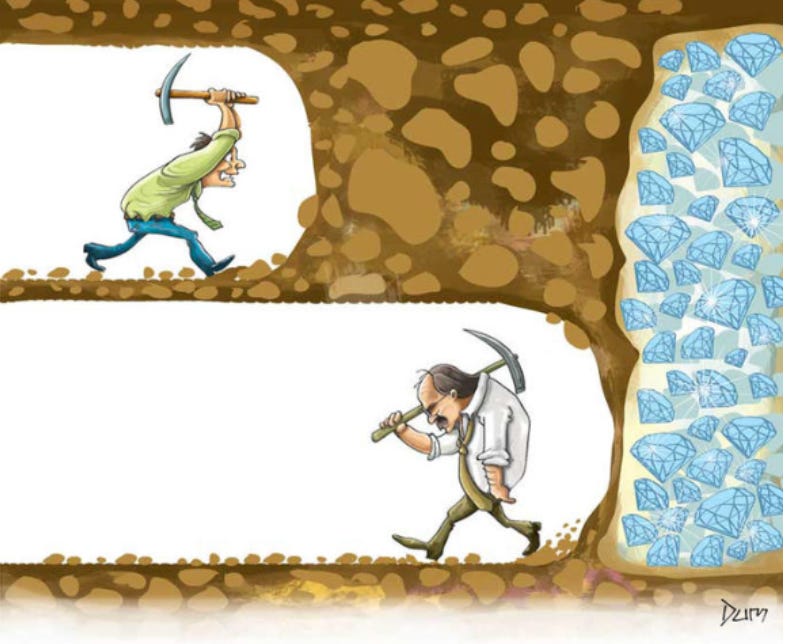 Women waiting for a proposal after 4 years be like
Anyway, this next phase of my strategy involved making it very clear I wanted to be married by a particular age, based on the fact that I wanted children before a particular age. I expressly told my husband my fears about being strung along through my twenties. Thankfully, after some honest conversations, he gave me an amenable timeline, and then stuck by it. But this entire conversation was yet another risk that could have derailed the whole operation. What if he thought a twenty-three-year-old woman talking about marriage so bluntly was “creepy” and “suffocating” and decided to dump me over it? Many men reading this probably think I sound insufferable, but in fact, being insufferable is the only way to avoid the default path of just…not getting married at all. In fact, I worried about “being insufferable” a lot! Granted, I minimized this risk by selecting for a man who admitted he wanted marriage in the first place, but nothing is guaranteed. It’s not just hard work to get married—it’s also luck.
Some people will say that none of this really takes that much work because if a woman just had zero standards for attraction, she could marry anyone. I did not have to fall in love with a funny guy with a great body. But the same goes for men, for that matter. Most of the men who say single women should just date anyone would never date a single mom, a “fat girl,” a woman who wasn’t facially attractive, or an older woman, which automatically rules out the majority of women. And that’s fine, but it also means women can have standards too. My standards weren’t crazy. I did not have a height requirement or even height preference. I had absolutely zero requirements for income (what kind of twenty-year-old guy has non-trivial income in the first place?) Even when being relatively realistic about my options, it was hard to secure a husband on my timeline. My ex-boyfriend was less attractive than my husband by basically every metric and he was even less serious about the relationship, so I’m not convinced that just dating down is the answer.
Also, this was “easy mode.” I never had to do online dating. I never had to date in my twenties or balance dating with my work schedule. I never had a “situationship.” When I met Nick, I was reasonably attractive and surrounded by other young, attractive people, back in an era when people met randomly in person all the time. I cannot imagine how hard it is for marriage-minded young people today who are not part of an active real-life community. I still walk around in shock every day that I was actually able to pull it off and trap this man. But I digress.
It’s worth mentioning that relationships can break up for loads of reasons other than a timeline for a proposal, and I had to clear all those obstacles too. My husband is very opinionated and has a big personality. This isn’t a bad thing; to some extent I selected for this because I’m attracted to it. But this tendency means that I had to balance a desire not to be a total pushover with the fact that our natural dynamic necessitates my husband decides things most of the time. Long story short, I had to (and still have to) pick my battles. This is a bit of a revealed preference thing because almost all my ex-boyfriends got annoyed at me for not “calling them on their shit” and “telling them what to do” which sounded as unappealing as listening to a guy steal a bunch of Family Guy jokes as his own (also something I had to experience at the hands of an ex.) But anyway, battles were picked, such as the fact that for Nick’s job in tech, I moved to San Francisco, away from my family, and then started working in tech (which I didn’t particularly like either, but it was the Recession and the Novel Factory wasn’t hiring.)
Once we got married, we then had to contend with the issue of children. At the time, neither of us know that we were dealing with a severe case of random male-factor infertility necessitating IVF. Obviously, we are outliers in the fertility world. But before I knew about our future difficulties, I would have wanted to start trying to conceive the year after we got married, when I was 26 and he was 28. This felt too early to him, and we were still living in a one-bedroom apartment in San Francisco that was infested with black mold. He wanted to wait until we left the city and got a better place. Even after we got a better place, he wanted to wait until we had more money. We finally started trying when I was 28 and he was 30. This was later than I wanted, but in line with the original timeline I had provided (I wanted to have my first child by 30) and still earlier than almost all our peers. But I’m sure if some of the terminally online pronatalists saw my story without context, they would be under the natural assumption that it was I, not my husband, who wanted to wait until we were financially established, until I had gone to Prague, and until I had “leaned in” enough at some asinine women in tech conferences (also known as my personal hell.)
There’s also the pervasive belief that women are blissfully unaware of our reproductive timeline and believe we have all the time in the world while we fritter away our reproductive years on useless pursuits like college (never mind that college is a great hack for husband-finding even if you aren’t academically inclined.) I can’t say for certain if this is untrue of everyone—there are certainly women who are overly confident about egg freezing, and who think the “geriatric pregnancy over 35” thing is a sexist and obnoxious term with zero medical basis at all. But especially lately, our culture is full of messages warning women about their declining fertility. An unmarried woman over twenty-four cannot tweet a photo of herself without a brigade of weirdos warning her of her impending sterility. Every day, I see men confidently declare that getting pregnant after thirty is “difficult.” Yes, I know there is always someone commenting on these discussions with, “That’s not true! My mom was 45 when she had me!” but for the most part, I think young women are aware that their fertility is not eternal. The people who are less likely to be aware (or think about it at all) are their boyfriends or husbands. The issue isn’t that women don’t know their fertility declines with age; the issue is that we deride women as “baby crazy” for bringing up these timelines with men—either they’re too young to be talking about it, or if they’re “old enough” to care about it, they’re baby-rabid losers running out of time. Realistically, women just need to unionize. Luckily, it’s super easy for women to unanimously agree on things, especially deeply personal things.
So here I am, married with two kids at thirty-six. The obvious, hum-drum default, right? Hardly. It feels like I’ve done an exhausting amount of work to get to a place where my ancestors probably found themselves without trying at all.
Obtaining marriage/kids in modern day (especially post-covid) is doable but fairly labor-intensive, requiring a tremendous amount of work and strategy from both parties, not to mention sheer luck. This is magnified tenfold if you want these things at young ages, but aren’t in a religious or conservative environment. I believe it gets a bit easier as you get older, provided you’re a good catch. Invariably, all my single-at-thirty friends from San Francisco are now married in their forties with kids, usually to men around their age who moved pretty quickly. But I doubt any of them will have three children. Many will likely stop at one. And almost all of them would have preferred to marry and have kids earlier.
I would venture that there are far more “unmarried but wishes they were married” people out there than “married against their will” people. Many married people who only have one child probably would have wanted two or more. Telling people to “get married and have kids” or “don’t want too long to get married” may be a noble pursuit, but a lot of unmarried people, especially women, aren’t actively resisting marriage. They may be aggressively pursuing marriage, and just getting nowhere, because ultimately, achieving matrimony in 2025, provided you want a partnership with genuine mutual attraction and shared values, isn’t that easy. Yes, even if you are attractive and extroverted.
Now every time I look at my husband and kids, I feel like I’ve climbed Mount Fuji in stilettos. It feels so improbable for me to have done this thing that, for most of human history, was an obvious given. Sometimes, when I’m out with my family around happy hour and I see young women on their way to the bars, I wonder how many of them want a life like mine fifteen years from now, how many of them are on their way to the bars in the hopes of meeting someone who will be part of that life, and how many of them will get it—and not only get it, but get it without having to compromise too much. Maybe it was only so much work for me because I overanalyzed everything, or because my standards were too high. But I can’t help but feel that everything about how society functions today makes it harder and harder to just “come by” marriage and kids. For better or worse, anyone who manages to get married must really, really want it—and those who aren’t married are likely already trying pretty hard.
Write a comment