OpenAI’s $230 Codex Keyboard Marks Serious AI Bet Amid Oddball Merch and Legal Heat
OpenAI’s $230 Codex Keyboard Marks Serious AI Bet Amid Oddball Merch and Legal Heat
OpenAI’s first branded gadgets arrive with conflicting signals: a $230 mini-keyboard pitched as a “command center” for AI coders, and a $70 ChatGPT basketball that looks more like swag than infrastructure. Together, they blur the line between serious tooling and novelty merch just as the company faces a high‑stakes hardware lawsuit.
Early hardware ambitions take shape
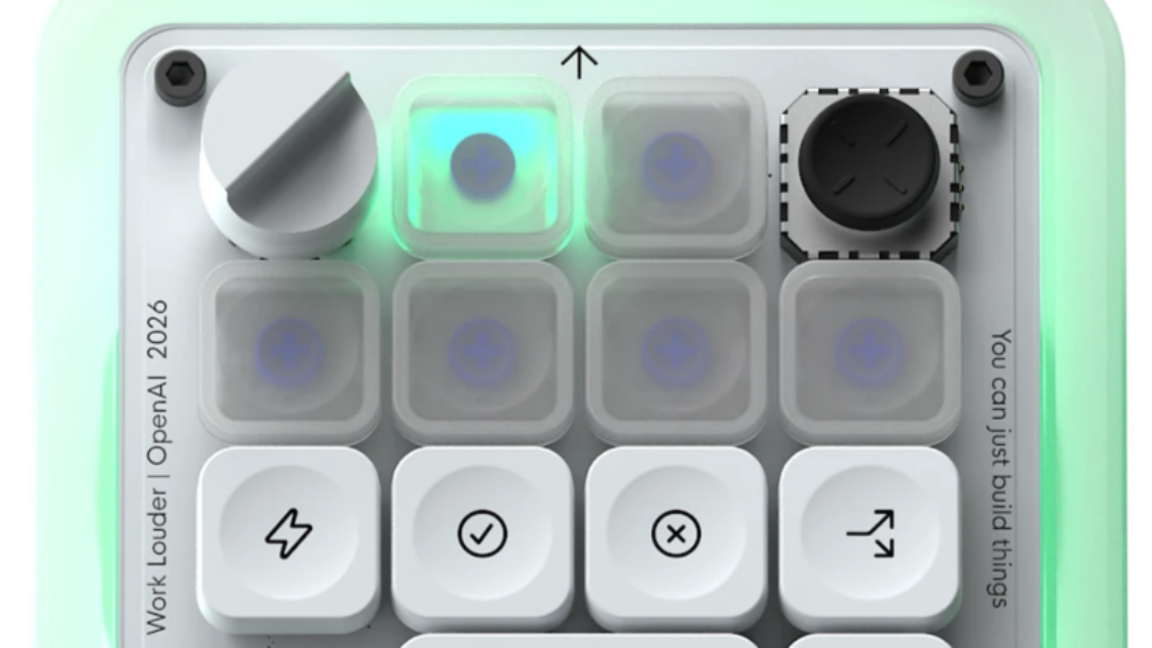
As rumors mounted that OpenAI was working on a personalized smart speaker and other devices, the company on July 15 quietly launched its first branded hardware, the Codex Micro, a specialized RGB‑lit mini‑keyboard for Codex agents. The square keypad, built in a “limited-run collaboration” with boutique keyboard maker Work Louder, closely resembles Work Louder’s existing Creator Micro line but adds six frosted keys that give a live, color‑coded view of up to six Codex threads at a glance.
Axios framed it as a physical keypad that lets “agentmaxxers” monitor and control their AI “minions,” describing it as a shortcut box with backlit keys, rotary knob, and joystick that sits beside a regular keyboard. Business Insider likewise emphasized that the device is built “for Codex power users,” with light‑up keys for agent status, a joystick, and a dial to adjust reasoning level.
A niche tool and a market signal
TechCrunch reported that OpenAI is using the Micro as a “command center for agentic work,” with status‑showing Agent Keys, customizable Command Keys, and a reasoning dial — but noted that OpenAI itself calls it a “limited-run collaboration,” signaling a novelty item rather than a mass‑market product. The Verge similarly stressed that Codex Micro will be sold only “while supplies last,” with 13 mechanical switches, joystick, dial, and touch sensor, and six frosted keys offering a “live view of your Codex threads.”
At the same time, Axios and TechCrunch both link the launch to OpenAI’s broader hardware roadmap: a separate, more consequential, screenless smart speaker with moving mechanical elements, reportedly designed by former Apple engineers and aiming for a 2027 release.
From coders’ desks to courts and courtside
Business Insider casts the Micro as proof that OpenAI is “all in on Codex,” noting 8 million active users across Codex and ChatGPT Work and positioning the device as another step in making “vibe coding” easier and more tactile. Axios argues the keypad hints at a future where workers manage fleets of AI agents with physical controllers at their desks and voice‑driven companions in their homes.
But TechCrunch also highlights the awkward timing: OpenAI’s keyboard debut lands “amid hardware legal battle” as Apple sues over alleged trade secret theft tied to ex‑Apple engineers now designing OpenAI’s upcoming device. The Verge notes that the Ive‑related project is now under fresh scrutiny because of that lawsuit.
One day after the keyboard reveal, TechCrunch surfaced an even stranger item: a $70 ChatGPT basketball, marketed as part of a “Pause. Play. Prompt.” campaign and framed as a “physical reminder that creativity doesn’t just live on our screens.” The author questions who would buy or publicly use a branded AI ball, likening it to other tech‑industry misfires and pointing to the irony of a creativity‑and‑wellness message from a sector driving up carbon emissions.
Across these launches, a pattern emerges: OpenAI is testing how far its brand can stretch into physical objects — from niche, high‑end tools for 8 million coders to lifestyle curiosities — even as its most serious hardware ambitions, and legal risks, remain just over the horizon.
[1] Ars Technica – “OpenAI’s first branded hardware is… a light-up keyboard?” – As rumors continued about a personalized smart speaker, OpenAI rolled out the $230 Codex Micro, a mini-keyboard to monitor and interact with multiple Codex agents, featuring six frosted keys for color-coded feedback on up to six threads.
[2] The Verge – “OpenAI finally launches hardware… for Codex” – The Codex Micro, a square block of buttons co-built with Work Louder, costs $230, mirrors Work Louder’s Creator Micro 2 layout, includes 13 switches plus joystick and dial, and six frosted keys that provide a “live view of your Codex threads,” sold only while supplies last.
[3] Axios – “OpenAI limited collab is a physical keypad for AI” – Axios describes Codex Micro as a limited-edition desktop keypad for “agentmaxxers” to monitor and control AI “minions,” with customizable keys, push-to-talk, and a reasoning dial, positioning it as part of a broader shift toward physical AI controllers and a forthcoming ChatGPT smart speaker.
[4] Business Insider – “OpenAI’s new $230 device is for Codex power users” – Business Insider calls Codex Micro OpenAI’s first hardware product, a mini keyboard with light-up status keys, joystick, reasoning dial, and customizable shortcuts, and cites OpenAI’s Thibault Sottiaux saying Codex and ChatGPT Work now have 8 million active users.
[5] TechCrunch – “Amid hardware legal battle, OpenAI releases a $230 keyboard for Codex” – TechCrunch says the Codex Micro, co-designed with Work Louder, is a “command center for agentic work” with Agent Keys, Command Keys, joystick, and reasoning dial, and notes it’s a limited-run novelty arriving as Apple sues OpenAI over alleged hardware trade theft tied to a planned smart, screenless ChatGPT speaker.
[6] TechCrunch – “Why is OpenAI selling a ChatGPT basketball?” – In a follow-up, TechCrunch reports OpenAI is also selling a $70, 100% rubber ChatGPT basketball under a “Pause. Play. Prompt.” campaign as a reminder that creativity isn’t only on screens, while questioning who would use such a branded ball and noting the AI boom’s rising carbon emissions.
Continue reading https://foxvector.com/stories/019f79d3-e85d-2d11-72c5-206b8b37b857
Write a comment