OpenAI’s $230 ‘Codex Micro’ Keyboard Sparks Buzz as First Hardware Lands Amid Apple Legal Fight
OpenAI’s $230 ‘Codex Micro’ Keyboard Sparks Buzz as First Hardware Lands Amid Apple Legal Fight
OpenAI has stepped into hardware with a tiny, glowing keypad meant to control AI coding agents—just as the company faces a high‑stakes legal clash with Apple over alleged hardware trade‑secret theft. The move raises questions about whether this niche device is merely a flashy accessory or the first visible step in a larger hardware push.
Early hints and legal storm clouds
Reports had already detailed OpenAI’s broader hardware ambitions, including a portable, screenless smart speaker with moving mechanical elements designed by ex‑Apple engineers, a project now shadowed by Apple’s trade‑secret lawsuit. Apple’s complaint has put extra scrutiny on any OpenAI hardware effort, including devices still in development.
July 15: OpenAI’s first branded device arrives
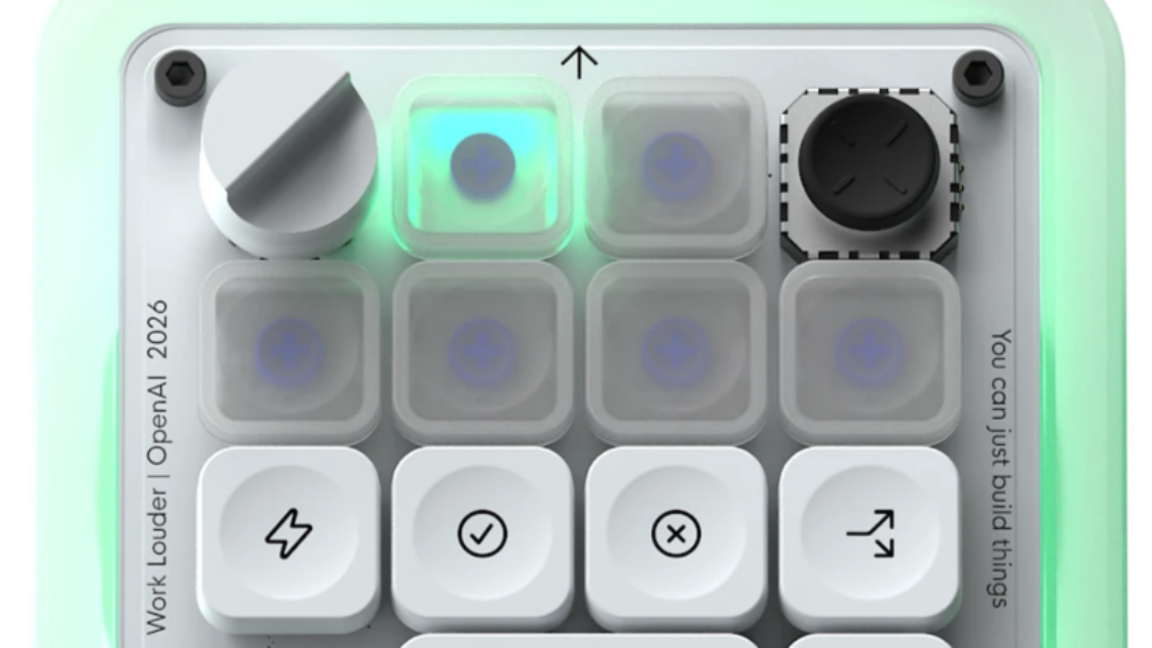
On July 15, OpenAI launched Codex Micro, a $230, RGB‑lit mini‑keyboard created with boutique keyboard maker Work Louder. The limited‑run pad is modeled on Work Louder’s existing macro hardware but carries prominent OpenAI branding and Codex iconography.
The square keypad features six frosted, backlit keys that provide a “live view” of up to six Codex threads, cycling colors to show whether tasks are idle, running, completed, require feedback, or have hit an error. A joystick, rotary dial, and configurable command keys let power users jump between agents, tweak “reasoning” levels, and trigger common actions like push‑to‑talk or accepting and rejecting code changes.
A niche gadget with bigger implications
Axios frames Codex Micro as a “physical shortcut box” and a remote control for AI “minions,” arguing it previews a future in which workers manage fleets of agents rather than a single assistant. Business Insider casts it as a tool squarely aimed at Codex power users and a signal that OpenAI is “all in” on its coding product, which now counts 8 million active users.
TechCrunch and The Verge emphasize that, despite the fanfare, Codex Micro is a limited‑run collaboration—a “novelty item” that mostly heralds OpenAI’s entry into hardware while the company focuses on a more consequential smart‑speaker device still to come.
1. TechCrunch – “Amid hardware legal battle, OpenAI releases a $230 keyboard for Codex” – OpenAI is “officially entering the hardware market” with a $230 light‑up keyboard for its Codex assistant, launched as Apple sues over alleged hardware trade theft.
2. Ars Technica – “OpenAI’s first branded hardware is… a light-up keyboard?” – Describes Codex Micro as an RGB‑lit mini‑keyboard whose frosted keys show live status of up to six Codex threads at a glance.
3. Business Insider – “OpenAI’s new $230 device is for Codex power users” – Calls Codex Micro a mini keyboard “built for power users” with status lights, a reasoning dial, joystick, and shortcuts, underscoring OpenAI’s bet on Codex and its 8 million active users.
4. The Verge – “OpenAI finally launches hardware… for Codex” – Notes the limited‑run collaboration with Work Louder, the resemblance to existing Creator Micro pads, and stresses that this is separate from OpenAI’s main smart‑speaker project with Jony Ive.
5. Axios – “OpenAI limited collab is a physical keypad for AI” – Frames Codex Micro as a niche, $230 remote control for AI agents that hints at a broader shift toward dedicated AI hardware, while Apple’s trade‑secrets lawsuit looms over OpenAI’s upcoming smart speaker.
Continue reading https://foxvector.com/stories/019f6801-ed31-129a-7181-31cf3d1257b0
Write a comment