Day 115: Building Intelligent Historical Data Archiving
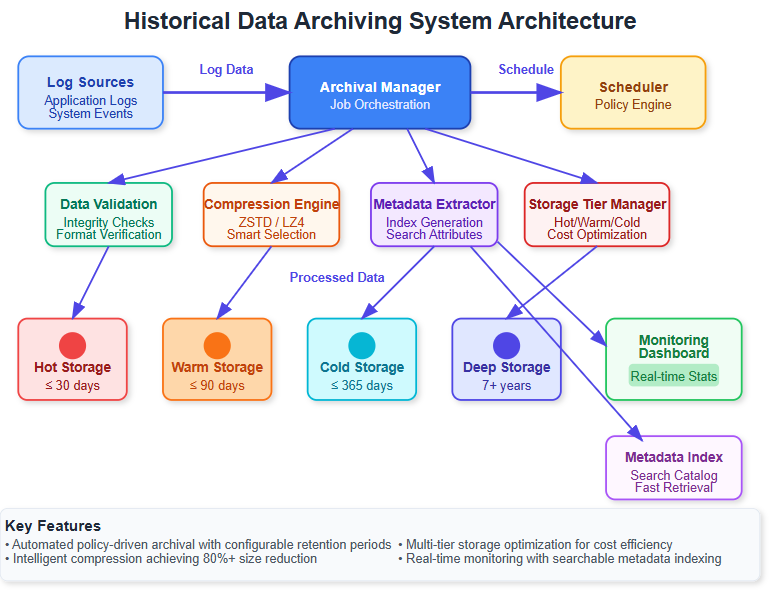
Day 115: Building Intelligent Historical Data Archiving
What We're Building Today
> Today we're implementing an intelligent archiving system that automatically moves aging log data to cost-effective long-term storage while maintaining instant searchability. Think Netflix's recommendation engine - they archive billions of viewing logs but can instantly retrieve patterns from years of data when needed.
Key Implementation Points:
Core Concepts: The Enterprise Data Lifecycle
### Storage Tier Intelligence
Modern enterprises operate on the "data temperature" principle. Fresh logs (hot data) need millisecond access, while year-old compliance logs (cold data) can tolerate minutes. Our archiving system automatically graduates data through temperature zones based on usage patterns.
### Compression Strategies That Scale
Raw logs contain massive redundancy. Our system applies different compression algorithms per data type - JSON logs get schema-aware compression achieving 90% reduction, while binary logs use general-purpose algorithms optimizing for speed over ratio.
### Metadata-First Architecture
The secret to fast archive retrieval isn't storing everything - it's storing the right index. Our system generates searchable metadata during archival, enabling instant queries without touching actual archived data.
Context in Distributed Systems
### Real-Time Production Applications
Banking systems archive transaction logs for regulatory compliance while maintaining sub-second fraud detection on recent data. E-commerce platforms store user behavior logs for machine learning while keeping active session data instantly accessible.
### Component Integration
Yesterday's lifecycle policies act as triggers for today's archival engine. Tomorrow's restoration service will leverage today's metadata indexing for lightning-fast data retrieval.
[
](https://substackcdn.com/image/fetch/$s!BPsK!,fauto,qauto:good,flprogressive:steep/https%3A%2F%2Fsubstack-post-media.s3.amazonaws.com%2Fpublic%2Fimages%2Fa1c54b9c-89ef-4b75-9865-45058c06dec3_770x596.png)
[Read more](https://sdcourse.substack.com/p/day-115-building-intelligent-historical)
You can include dynamic values by using placeholders like: https://drewdru.syndichain.com/articles/cdb6e201-18b3-4ffc-961c-747430ff08e7 , Drew Dru, https://sdcourse.substack.com/p/day-115-building-intelligent-historical , drewdru, drewdru, drewdru,
drewdru These will automatically be replaced with the actual data when the message is sent. https://drewdru.syndichain.com/articles/cdb6e201-18b3-4ffc-961c-747430ff08e7 drewdru