Police Seize Nearly 430 Kilograms of Tobacco in Golubinci
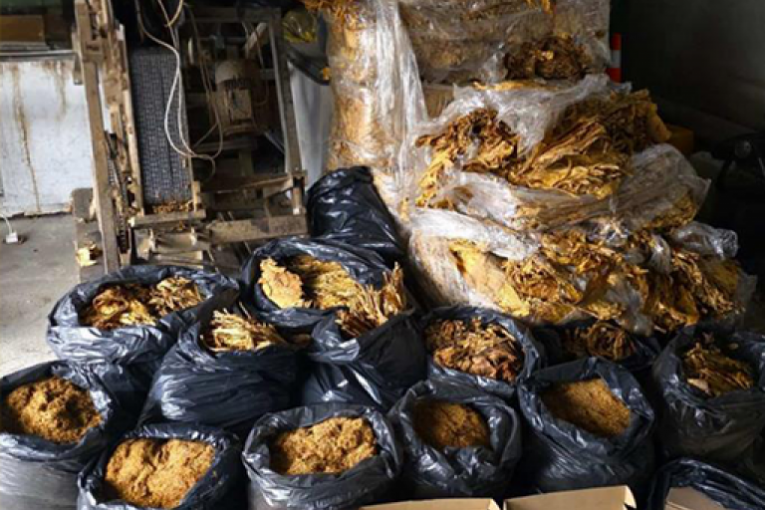
Police Seize Nearly 430 Kilograms of Tobacco in Golubinci pro-government Pro-government outlets present the seizure of nearly 430 kilograms of tobacco in Golubinci as a major success of police and prosecutorial work that prevented more than 4.8 million dinars in damage to Serbia’s budget. Their coverage emphasizes efficient institutions, strong enforcement against the gray economy, and the state’s role as a diligent protector of public revenues. @Republika Police in Sremska Mitrovica, acting on an order from the Public Prosecutor’s Office in Stara Pazova, searched a property in the village of Golubinci and seized nearly 430 kilograms of tobacco, including about 370 kilograms of leaf tobacco and just over 57 kilograms of cut tobacco, along with a tobacco-cutting knife. Both opposition and pro-government narratives would acknowledge that the operation took place in Serbia, that the material was found on a private property, that the amount is unusually large for personal use, and that the case has been formally tied to potential damage to the state budget.
Across the spectrum, outlets would agree that the case falls within the broader framework of combating illicit tobacco trade and tax evasion, that the Public Prosecutor’s Office and police are the key institutions handling such investigations, and that the state calculates damage based on unpaid excise duties and taxes. They would also share the view that such seizures are officially justified as necessary to protect budget revenues and uphold regulations governing tobacco production, processing, and sale, and that this incident fits into an ongoing series of actions against the gray market in excisable goods.
Points of Contention
Framing of the operation. Opposition-aligned outlets are likely to portray the seizure as routine police work that is being selectively amplified for propaganda value, questioning whether similar or larger cases go unpublicized when they do not serve the ruling party’s narrative. Pro-government media emphasize the operation as a major success in the fight against the gray economy, highlighting the precise quantities seized and the dramatic budget damage figure to showcase state efficiency. While opposition coverage may downplay its uniqueness and stress that such enforcement should be standard, pro-government reporting frames it as evidence of particularly vigorous and effective governance.
Political responsibility and systemic issues. Opposition sources would likely argue that the very existence of such a large illegal tobacco operation reflects systemic failure, weak institutions, and an entrenched gray economy tolerated under the current government. Pro-government outlets instead present the case as proof that institutions are functioning, suggesting that the discovery and seizure show that the state is actively closing space for illegal trade. Opposition narratives might question whether high-level political or crony networks are being protected and why enforcement appears selective, whereas pro-government narratives focus blame solely on local perpetrators and avoid linking the case to broader governance problems.
Use of economic and budget rhetoric. Opposition media would tend to question the headline claims of more than 4.8 million dinars in budget damage, treating such figures as inflated or instrumentalized numbers meant to justify tough policing and generate positive headlines for the authorities. Pro-government coverage foregrounds this estimated loss to the Republic’s budget, using it to stress the seriousness of the offense and to show the government as a defender of public finances. While opposition outlets might put these numbers in the context of larger alleged budgetary abuses or corruption at higher levels, pro-government outlets focus narrowly on this case to illustrate responsible economic stewardship.
Broader law-enforcement narrative. Opposition-aligned reporting would likely situate the case within a pattern where spectacular seizures are publicized, but court outcomes, repeat offenders, and the effectiveness of long-term enforcement remain murky or underreported. Pro-government media instead integrate the story into a broader narrative of successful police campaigns against smuggling, narcotics, and tax evasion, often treating this seizure as one more data point in a rising trend of “wins” for the state. Opposition voices may therefore stress continuity of problems and lack of systemic reform, while pro-government voices stress continuity of enforcement and incremental progress.
In summary, opposition coverage tends to treat the Golubinci seizure as a routine case used to mask deeper systemic failures and selective enforcement, while pro-government coverage tends to frame it as a clear sign of effective institutions, responsible budget protection, and a strong stance against the gray economy. Story coverage nevent1qqs9tkn2puj8dlwa8h0sxv8y53ncuggj2e5wyaqkc4y8a44gzhdyyfcs29yhm nevent1qqsy9uc33ek3srnxs0u92s8g8upp5namnwmqfsf3vk5m6zzh2pf5yrst6q2zv